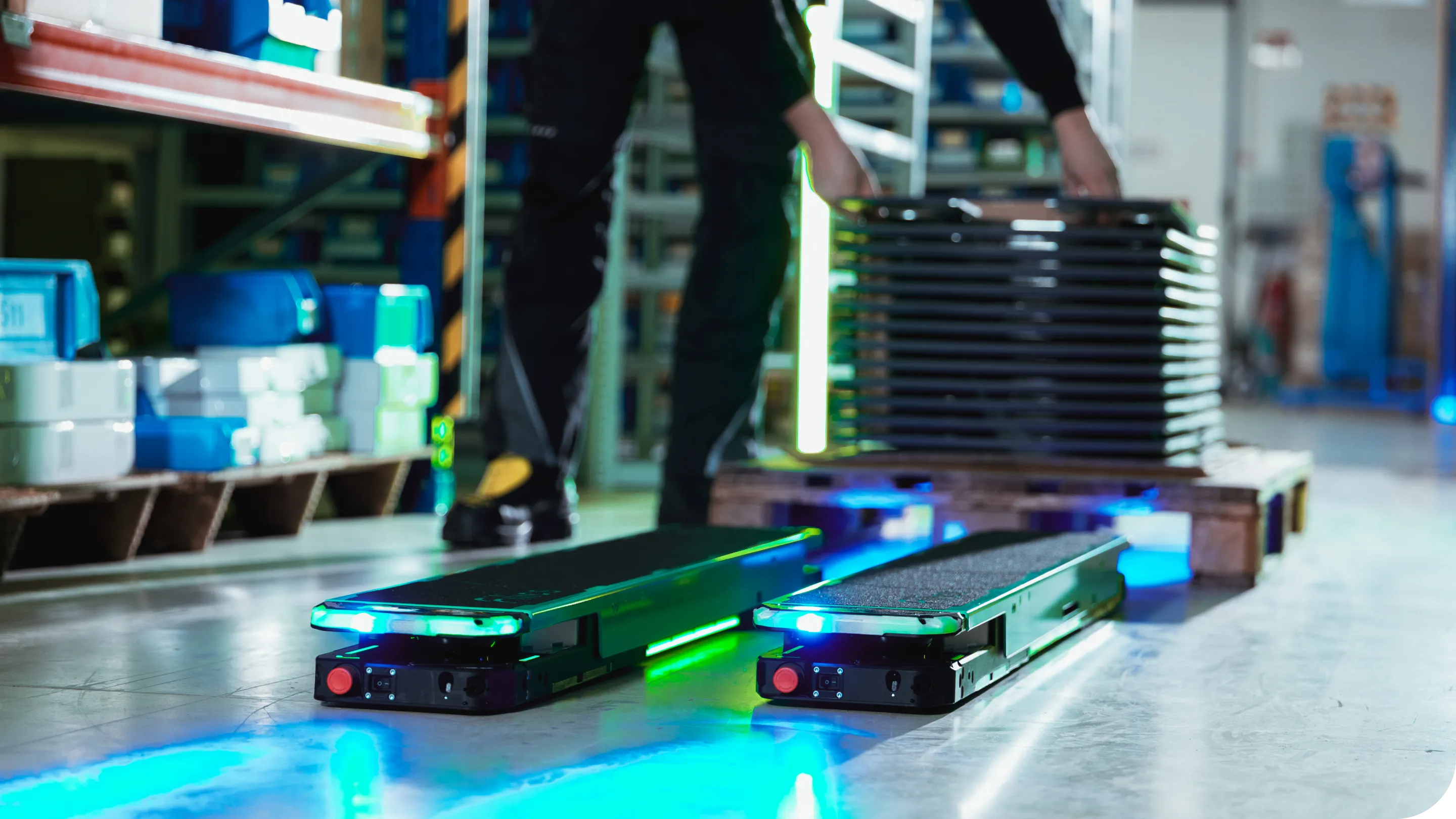
Filics is a technology company founded in Munich in 2019, specializing in autonomous intralogistics. Emerging from the Technical University of Munich, Filics develops innovative solutions for automated material transport in industrial environments from its headquarters in Munich – with the Filics Streamliner as its flagship product.
The name "Filics" stands for "Future in Logistics" and reflects the company's ambition to shape the intralogistics of tomorrow. Today, Filics employs more than 50 people at its Munich base and across Europe. In 2025, the company successfully closed a significant funding round with renowned venture capital partners – a milestone that is set to accelerate further growth and product development.
The Filics Streamliner is manufactured at the company's headquarters in Munich. The core components – including drive technology, motors, and chassis – are sourced from leading German manufacturers. Only select parts such as circuit boards and batteries are procured internationally.
The Filics Streamliner (consisting of two robot skids) transports loads of up to 800 kilograms. An increase in maximum payload capacity is planned for future versions.
Technical specifications, performance data, and requirements for minimum and ideal corridor widths are all available in our Filics Streamliner data sheet.
The Filics Streamliner is specifically designed for the EPAL standard and currently supports EPAL and H1 pallets. The range of supported load carriers is continuously being expanded, so that in the future, other load carriers that can be driven under by the unit will also be transportable.
The Filics Streamliner adapts to existing conditions and requires no extensive implementation measures. It is designed for indoor use only and requires smooth, level floors as well as stable, comprehensive WLAN coverage.
Transport orders are created via a user-friendly front-end on any device with just a few clicks. Integration with a WMS system is planned. Additionally, the Filics Streamliner supports the internal Milk Run, where it regularly drives to predefined zones and, when necessary, transports pallets to the destination.
Yes. Via the Filics user interface, customers can independently create new orders, define pick-up and delivery zones directly on the map, and set transport routes. The intuitive interface is browser-based, accessible on any device, and requires no programming knowledge whatsoever. Adjustments can be made at any time without external assistance – and should any questions arise, the Filics support team is always on hand to help.
Yes - parts of the VDA5050 standard are already integrated into the Filics Streamliner. Full implementation is currently under development.
The Filics Streamliner automatically moves to the charging station when needed or when no orders are pending. A full charging cycle takes approximately 30 minutes. Depending on the load weight and application, up to 6 hours of operation are possible on a single charge.
Our robots use lithium iron phosphate (LiFePO₄) batteries. This battery technology is considered significantly safer than conventional lithium-ion batteries: it is particularly thermally stable and poses a considerably lower risk of fire. Even if the battery were to be mechanically damaged, for example by a sharp object, it would not ignite. However, damage to the batteries is highly unlikely from the outset due to the system’s sturdy steel frame. As a result, the Streamliner offers the highest level of safety in terms of energy storage, especially in the sensitive environment of a shared workspace.
The Filics Streamliner meets all safety requirements according to DIN EN ISO 3691-4 and is CE certified. It is equipped with Blue Spots, LEDs, acoustic signals, and environmental sensors to ensure safe communication with humans.
If a person or object is in the path of the skids, they slow down in proportion to their current speed. However, they come to a complete stop at a distance of 10 cm at the latest. As soon as the obstacle is out of the way, the skids resume movement on their own.
Yes, on the floor plan of the hall in our software, specific zones – such as “crosswalks,” intersections, or danger zones – can be marked. You can specify whether the Filics robots should either slow down in these zones, not stop within the zone (e.g., at fire doors), or not enter the zone at all (e.g., stairwells, other staging areas).
The Streamliner runs entirely within the customer's own network, and the entire control logic is also processed directly on the robot on site. This means that operational data never leaves the environment at any point, and our customers retain full control over access, interfaces, and security standards, fully in line with their internal policies. In addition, Filics is prepared for the requirements of the Cyber Resilience Act (CRA). This ensures that our system will also meet the increasing regulatory and security-related requirements in the future.
Yes. In Germany and Austria, Filics handles service, maintenance, and implementation with its own qualified personnel. In other countries, Filics works with local partners who cover sales, implementation, and service and maintenance on-site.
Depending on the application and shift model, a return on investment of approximately 12 to 18 months is achievable.
The Filics Streamliner is available for both purchase and rental. A leasing option is currently in planning and will be offered in the future. For more information, please reach out to us via our contact form.
No. For safety reasons, the load must remain within the dimensions of the pallet. Overhanging loads are not covered by the Streamliner's safety systems and must therefore not be transported.
If only the load on the pallet is wrapped, the Streamliner can transport it without issue. However, the pallet feet must remain free of wrapping film.
Not at this time. The Filics Streamliner is designed to transport Euro pallets and comparable load carriers using two synchronised robots. Combining four, six, or more units for particularly large or heavy loads is theoretically conceivable and may become part of the long-term product roadmap. The next development step will focus on enabling the transport of half pallets and small trolleys using a single unit.
No. The Filics Streamliner is designed exclusively for use in enclosed spaces and indoor facilities. Outdoor operation is not supported.
There are several ways to experience the Filics Streamliner firsthand: at numerous trade shows and events, you can see it live in action – an overview of upcoming events is available here on our website. We are also happy to visit your site and conduct a live demonstration directly in your warehouse or production facility. Simply describe your use case as detailed as possible via our contact form.
Every project also includes a one-week Proof of Concept: our team tests the agreed use case on-site extensively before the actual implementation begins.